
CABLE TESTING AND DIAGNOSTICS

The decision to replace a medium-voltage cable is rarely straightforward. It involves high costs, plant downtime, mobilization of field crews, and a direct impact on the reliability of the electrical system. For many years, the dominant practice has been to adopt simplified criteria, generally based solely on cable age: Once a certain number of years has passed, replacement is planned.
However, experience shows that operating time, by itself, is an imperfect indicator of the end of life. There are very old cables in excellent condition, as well as relatively young cables that exhibit accelerated degradation due to factors such as load profile, thermal stress, environmental conditions, and poor installation quality.
This is why field diagnostic testing is becoming increasingly important as a central tool for safely extending the life of cable service. Diagnostic testing directly measures the electrical behavior of the insulation and the integrity of the metallic shield rather than assuming that all segments of an installation age the same way. Based on these data, it is possible to determine whether a cable can remain in service, requires only periodic monitoring, or truly demands immediate intervention.
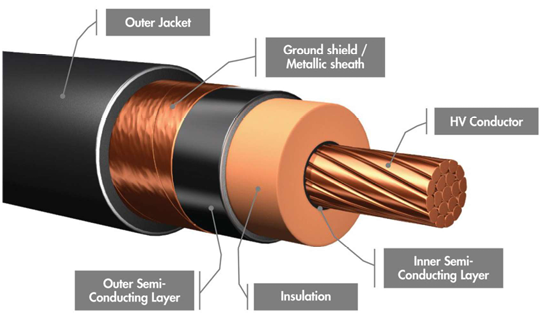
Evaluating the service life of medium-voltage cables begins with understanding their construction. Unlike low-voltage cables, which typically include only a conductor and insulation, medium-voltage cables incorporate several functional layers. These layers include the conductor, inner semiconducting layer, insulation, outer semiconducting layer, metallic shield, separator, and outer jacket (Figure 1).
Over the years, polymeric insulation has been subject to the formation of water trees as well as other dielectric aging mechanisms. The metallic shield may experience corrosion and discontinuities, which can compromise control of the electric field and its ability to conduct fault currents. When these two elements remain in good condition, it is common for the cable to continue operating well beyond the frequently cited typical service life of 25 to 30 years under nominal load.
Thus, the more important question is not, “How old is the cable?” but rather “What is the actual condition of the insulation and the shield?” Diagnostic testing exists precisely to answer this second question.
Over the last few decades, very low frequency (VLF) tan delta testing has become one of the reference methods for assessing the insulation condition of extruded cables. The principle is straightforward: Every insulated cable can be modeled as a capacitor, in which part of the current is purely capacitive and part is associated with dielectric losses. The tan delta value represents the ratio between these components; the higher the value, the greater the losses and, in general, the worse the condition of the insulation.
Testing at VLF offers two decisive advantages. First, it allows the application of voltage levels representative of cable operation without inducing destructive stress, unlike some direct-current tests that can accelerate material degradation. Second, combining parameters such as the mean tan delta at 1 U₀, the standard deviation (SDTD), and the tan delta (ΔTD) between different voltage levels provides a highly sensitive picture of the degree of aging.
International guides, such as IEEE 400.2, associate test results with three decision categories:
By translating numerical test results into critical classes, the method converts an abstract electrical quantity into operational information that is useful to asset managers.
Time domain reflectometry (TDR) complements insulation assessment by examining the metallic shield. By injecting short-duration pulses and observing the reflections along the cable, it is possible to identify significant discontinuities in the shield, typically associated with regions of high resistance caused by corrosion or breakage.
Practical experience and the IEEE 1617 standard itself demonstrate that the technique is sensitive to more severe damage, typically above approximately 25% of the shield cross-section. This makes TDR particularly useful for identifying critical segments that may compromise fault performance and the overall system integrity.
Combined with tan delta testing, TDR enables the classification of cables in terms of both dielectric failure risk and their ability to perform their function of conducting short-circuit currents. In this context, extending service life is acceptable only if both functions remain adequately preserved.
The practical application of this approach can be illustrated by a diagnostic testing campaign carried out at a large industrial facility in the interior of São Paulo. In total, 207 medium-voltage cables (13.8 kV) were evaluated over a few days using VLF/tan delta and TDR testing, which involved a field team as well as specialized data preparation and analysis.
Although the company’s headquarters had already determined that the cables should be replaced, since many of them were approaching the projected service life of about 30 years, the local unit adopted a more cautious strategy. Before committing to a high-cost, large-scale replacement program, it decided to conduct a few days of diagnostic testing to evaluate the actual condition of the insulation and the metallic shield. This approach enabled the decision to be based on objective data, thereby avoiding premature replacements and accurately identifying which cables truly required immediate attention.
The tan delta results, interpreted in accordance with IEEE 400.2, showed the following distribution:
In parallel, 51 TDR tests were performed, and no anomalies consistent with severe shield degradation (greater than 25% loss of metallic shield cross-section) were detected. This reinforced that the primary concern at that moment was centered on insulation condition.
A particularly relevant finding was that 108 cables, many of which were among the oldest in the plant (with more than 30 years of service), presented results consistent with acceptable operating conditions. In a maintenance strategy based solely on age, most of these cables would have been automatically included in replacement plans. However, diagnostic tests showed that they could remain in service safely, postponing the need for intervention.
At the other end of the spectrum, 57 cables were identified as having a high probability of failure, supporting recommendations for the replacement of sections, splices, and terminations, especially in circuits most critical to the industrial process. Between these two extremes, an intermediate group of cables was classified as “future study needed,” indicating the value of repeating measurements within one to two years to track the evolution of tan delta and determine the most appropriate moment for intervention.
The main advantage of this approach is that it organizes cable population into three well-defined groups:
In all scenarios, the cable’s service life ceases to be a statistical assumption and becomes a variable managed through data.
Extending the service life of cables does not mean postponing the problem. The central point is that by systematically measuring the condition of the insulation and the metallic shield, the company gains access to objective risk indicators. Instead of scheduling large-scale replacements of cables that are still in good condition, it directs resources toward those that truly present a higher probability of failure.
In the case study, this meant keeping more than 100 cables in service that, under an age-based maintenance strategy, would otherwise have been replaced automatically. At the same time, the 57 critical cables were identified and prioritized. The direct consequence is a smoother investment curve, fewer unplanned outages, and greater availability of the plant’s power assets.
From an engineering perspective, there is an additional benefit: The measurement history enables the comparison of how different circuits respond over time to the same operating conditions. This helps identify systemic installation issues, drainage problems, and sections that are more exposed to moisture or mechanical stress, guiding mitigation measures that extend far beyond simply replacing a cable.
Tan delta and TDR testing, when performed as isolated actions, already provide value. However, their true potential emerges when they are incorporated into a predictive maintenance program with periodic retesting, database updates, and integration with investment planning.
In this perspective, each campaign functions as a high-resolution snapshot of the cable population. Comparing successive campaigns reveals the aging rate of each section. Cables that remain stable may have their retesting interval extended, while those showing accelerated degradation are given priority for replacement or localized repairs.
Over time, the combination of diagnostic data and operational history allows the question, “How long can this cable continue operating?” to shift from a conservative guess to a technically grounded answer. In other words, diagnostic tests convert theoretical service life into managed service life.
This experience demonstrates that it is possible to combine technical rigor, extended cable life, and reliability. Instead of making decisions based solely on age, the company evaluated 207 cables individually using methods consolidated in international standards, obtaining a detailed map of its medium-voltage network. Based on this map, it was able to keep dozens of older cables in operation, monitor those in intermediate condition, and take decisive action where the risk was elevated.
By doing so, the company optimized investments, avoided failures, and created the foundation for a continuous improvement cycle. Each new test enhances the data set, improves the understanding of aging in service, and makes future planning more accurate. In this way, diagnostic testing is not merely a one-time health check but also a strategic tool for safely extending the service life of medium-voltage cables while strengthening the reliability of industrial electrical systems.
[1] IEEE Standards Association. IEEE Std. 400.2-2024, IEEE Guide for Field Testing of Shielded Power Cable Systems Using Very Low Frequency (VLF) (Less Than 1 Hz), 2024.
[2] IEEE Standards Association. IEEE Std. 1617-2022, IEEE Guide for Detection, Mitigation, and Control of Corrosion on Metallic Shields of Medium-Voltage Underground Cables, 2022.
This article was written and published in NETAWORLD magazine, Spring 2026 Industry Topics edition.
Authors: Nilson Baroni Jr., Daniel Bento and Rafael Morgado, Baur USA Corp, and Danilo de Souza, USMT

Tan Delta, also known as the dielectric loss factor...

Whether during the commissioning stage or operation, it is...

The Tan Delta technique makes it possible to obtain...